Update (November 2026): Basalt raises $5M and refocuses on self-improving agents
Basalt has not been acquired. In December 2025, the startup founded by Guillaume Marquis and François de Fitte raised $5 million from Entourage and Peak, with Alpha Star, Kima Ventures and Hexa. It is headquartered in San Francisco, with its tech team in Paris. Swan and HealthHero are among its named customers.
Since then, the product has evolved. Basalt now presents itself as the infrastructure for self-improving agents: every night it pulls your AI assistant’s conversations (from Langfuse, Braintrust, Datadog or a custom source), clusters recurring failures, and every morning opens a pull request with a fix: system prompt, tool definition or few-shot examples. Each fix is first checked against your golden dataset: if it breaks a case that used to work, the pull request is not opened.
Pricing has changed too: you only pay for merged pull requests, the first three are free, with no subscription or credit card.
The overview below describes the platform as we tested it in 2025. Its building blocks (prompt management, datasets, experiments, observability) are still documented and underpin the new workflow.
Overview
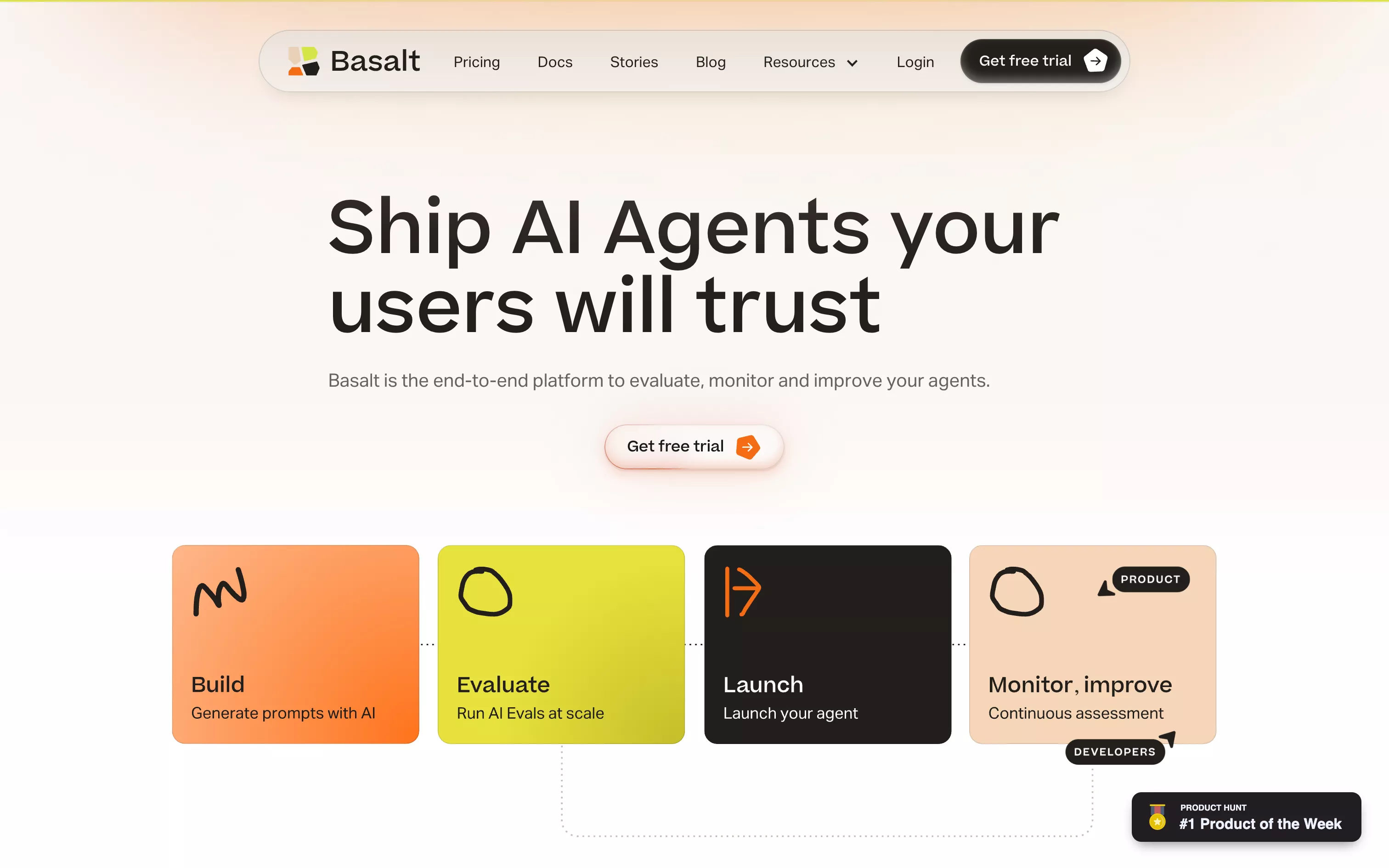
Basalt is a complete hub for orchestrating every stage of an AI-powered feature’s lifecycle. It includes an assistant (Copilot) to design and refine your prompts, structured evaluation tools (automated or human), an SDK to deploy easily into your products, and a monitoring system to keep an eye on performance such as latency or hallucinations. It encourages collaboration between product, engineering and domain experts in a single flow.
Pros
- Integrated AI workflow
From prompt to production, including testing, deployment and monitoring. - Powerful Copilot
Helps you generate and iterate on prompts while comparing several models. - Structured testing
Systematically evaluate performance with real datasets, metrics and AI audits. - Simple deployment
A flexible SDK to integrate prompts into your app without friction. - Proactive monitoring
Real-time tracking, automatic alerts, traceability and anomaly diagnosis. - Collaborative mindset
Designed so that everyone involved (product, tech or domain) can take part in building AI.
Cons
- Custom pricing
The Pro plan requires contacting the team to get a tailored offer. - Learning curve
Mastering AI monitoring, the test pipeline or the SDK takes some time for new teams.
Studio Elias’s recommendation
At Studio Elias, Basalt is becoming our ideal platform to:
- Build reliable AI features while staying in control of performance.
- Iterate quickly on prompts in a tested, monitored and documented environment.
- Collaborate efficiently between product designers, developers and AI experts.
- Ensure the long-term reliability and robustness of our AI integrations.
Basalt adds a layer of trust to AI deployments, essential for shipping products that actually work.
This shift makes Basalt especially relevant for teams that already run an AI assistant in production and have a code repository: it does not replace prompt design, but it automates the “spot the failure, fix it, make sure nothing breaks” loop. For a first prototype, the original platform remains a solid base.